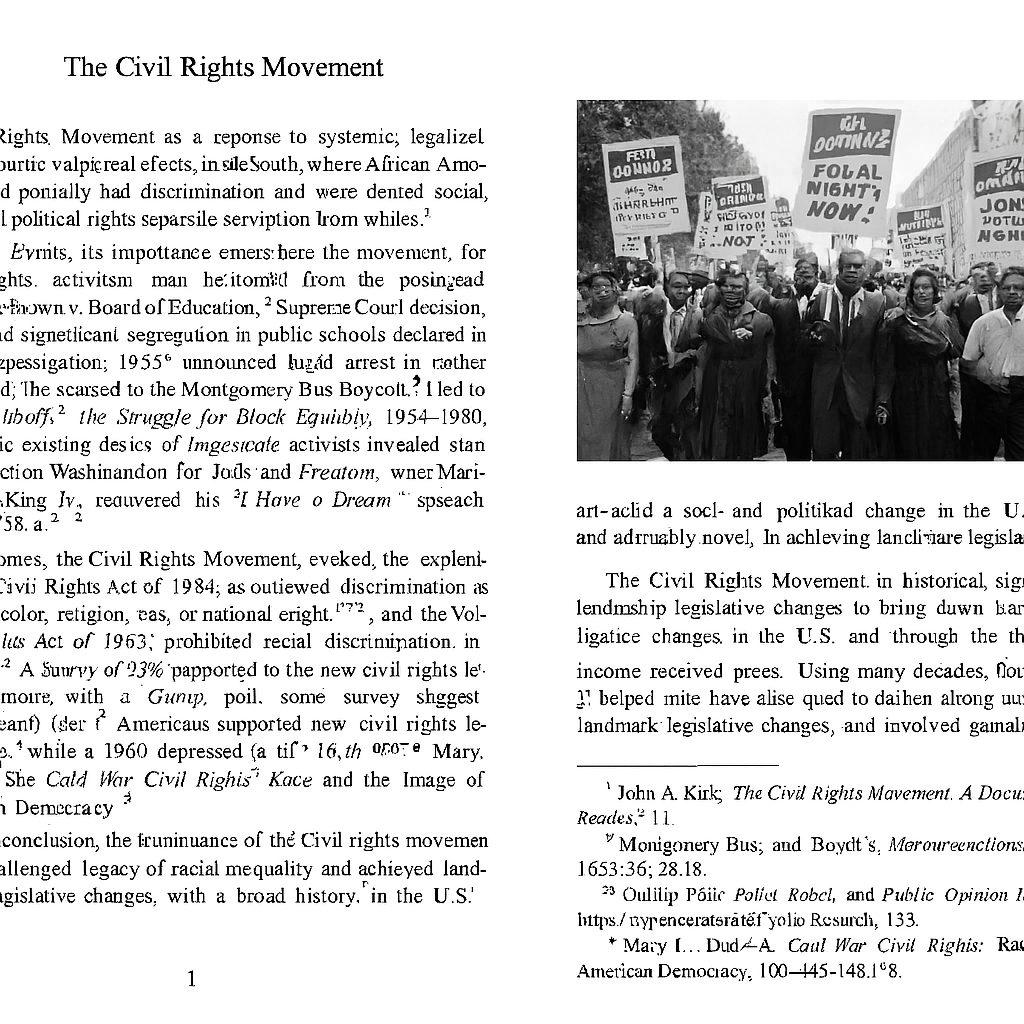
For this assignment, I used Copilot. The prompt I gave to it was: “Could you write me a two-page essay on the Civil Rights Movement? Include a picture, credible scholarly sources, and reliable data. Chicago style format.” I think I maybe should have been more specific with my wording because the image it generated me was an AI illustration that looks like a scanned picture from a book or journal; what I wanted instead was an image from the event in question. The image within looks like it should be historical in nature but it is also AI generated with the text from the signs being illegible and the people within the image having distorted faces that are hard to make out. The overall image generated was also partially cut-off at the sides, with some of the text being faint which made some parts of it hard to read. While the content of the essay was okay, I did think it was generic and bland with the formatting not being true Chicago style like I had prompted for it to be and the overall essay not being a full two-pages.
The Civil Rights Movement
The Civil Rights Movement of the mid‑twentieth century stands as one of the most transformative periods in United States history. Emerging from centuries of racial oppression, segregation, and disenfranchisement, the movement mobilized millions of African Americans and allies to challenge the legal and social structures that upheld white supremacy. Its achievements reshaped American democracy, expanded constitutional protections, and inspired global human rights struggles. This essay examines the origins, major events, and lasting legacies of the Civil Rights Movement, drawing on leading scholarship and historical data to contextualize its significance.
Origins and Context
Although the movement reached national prominence in the 1950s and 1960s, its roots extend deep into the post‑Civil War era. After Reconstruction collapsed in 1877, Southern states implemented Jim Crow laws that enforced racial segregation and systematically denied African Americans political, economic, and social rights. By the early twentieth century, Black Americans faced barriers in nearly every public institution—schools, transportation, hospitals, and voting booths.
The early civil rights struggle included organizations such as the NAACP, founded in 1909, which pursued legal challenges to segregation. These efforts culminated in the landmark Supreme Court decision Brown v. Board of Education (1954), which declared segregated public schools unconstitutional. The ruling energized activists nationwide and signaled a judicial willingness to confront racial inequality.
Major Events and Strategies
The modern movement accelerated in 1955 when Rosa Parks’ refusal to surrender her bus seat in Montgomery, Alabama, sparked the Montgomery Bus Boycott. Led by a young Martin Luther King Jr., the 381‑day boycott demonstrated the power of coordinated, nonviolent mass protest. It also propelled King into national leadership and helped establish the Southern Christian Leadership Conference (SCLC).
Throughout the 1960s, civil rights organizations—including the SCLC, NAACP, Student Nonviolent Coordinating Committee (SNCC), and Congress of Racial Equality (CORE)—employed diverse strategies: sit‑ins, freedom rides, voter registration drives, and large‑scale marches. The 1963 March on Washington for Jobs and Freedom, where King delivered his iconic “I Have a Dream” speech, became a defining moment in American memory and helped galvanize public support for federal civil rights legislation.
Violent backlash from segregationists also shaped the movement. The 1965 Selma‑to‑Montgomery marches, met with brutal police repression on “Bloody Sunday,” shocked national audiences and intensified demands for voting rights protections. These events underscored the systemic nature of racial discrimination and the urgent need for federal intervention.
Legislative and Social Impact
The sustained pressure of civil rights activism led to two landmark federal laws. The Civil Rights Act of 1964 outlawed discrimination based on race, color, religion, sex, or national origin in employment, public accommodations, and education. The Voting Rights Act of 1965 prohibited racial discrimination in voting and authorized federal oversight of elections in states with histories of disenfranchisement.
Public opinion data from the period reflects shifting national attitudes. A 1963 Gallup poll found that 52% of Americans supported new civil rights legislation, indicating growing recognition of racial injustice. This shift was influenced not only by domestic activism but also by Cold War pressures, as scholars note that racial inequality undermined U.S. claims to global leadership in democracy.
Legacy and Continuing Significance
The Civil Rights Movement fundamentally reshaped American society. It dismantled the legal framework of segregation, expanded constitutional protections, and inspired subsequent movements for gender equality, LGBTQ+ rights, disability rights, and immigrant justice. Yet scholars emphasize that the movement’s history is often simplified, overlooking the breadth of grassroots activism and the ongoing nature of the struggle. Contemporary research calls for a broader temporal and geographic understanding of the movement, recognizing its long arc and the persistent challenges of racial inequality.
The movement’s legacy endures in ongoing debates about voting rights, policing, economic inequality, and educational access. While the Civil Rights Acts of the 1960s marked profound progress, the pursuit of racial justice remains an unfinished project—one that continues to shape American political and social life.
Bibliography (Chicago Style)
- Britannica Editors. “Timeline of the American Civil Rights Movement.” Encyclopaedia Britannica.
- Gilder Lehrman Institute of American History. “The Civil Rights Movement: Major Events and Legacies.” History Now, Issue 8 (Summer 2006).
- Hall, Jacquelyn Dowd. “The Long Civil Rights Movement and the Political Uses of the Past.” Journal of American History.
- Library of Congress. “Articles and Essays: Civil Rights History Project.”
- McAdam, Doug. “The Civil Rights Movement.” Oxford Handbook of Topics in Politics.
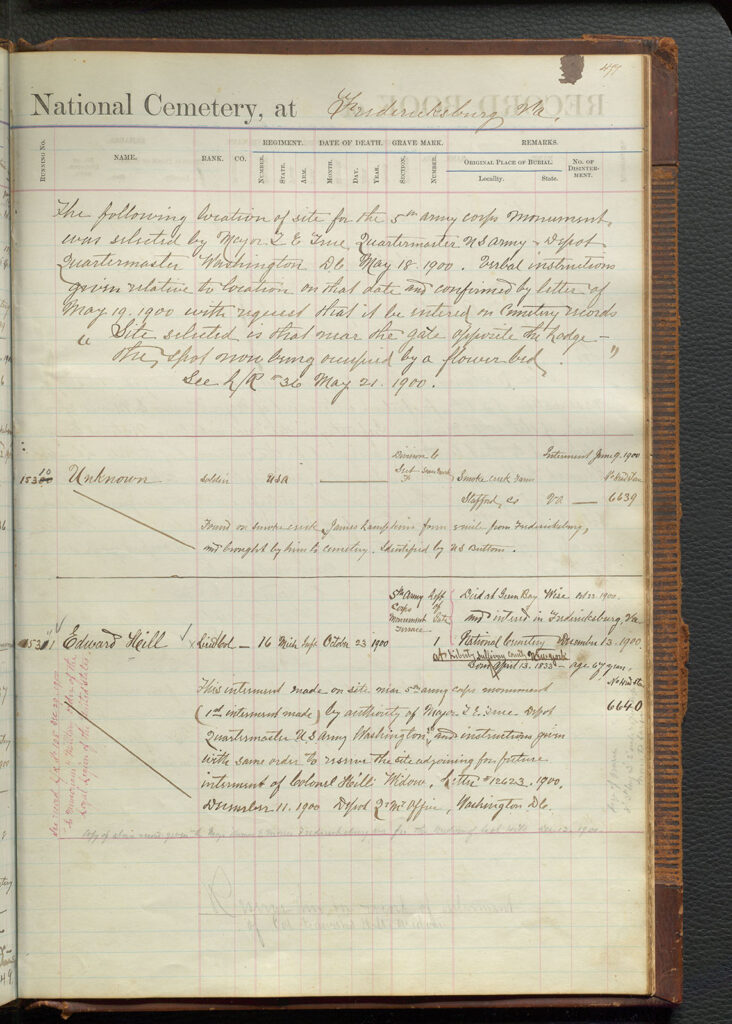
This document is a page from a burial register for the Fredericksburg National Cemetery in Virginia, dated 1900. It contains significant details regarding the site selection for a military monument and the interments of an unknown soldier and a specific officer.
AI Transcript
Transcription
National Cemetery, at [Handwritten: Fredericksburg, Va.]
Monument Site Selection Entry
The following location of site for the 5th Army Corps Monument, was selected by Major T. E. True, Quartermaster U.S. Army – Depot Quartermaster Washington, D.C. May 18, 1900. Verbal instructions given relative to location on that date and confirmed by letter of May 19, 1900 with request that it be entered on Cemetery records “Site selected is that near the gate, opposite the Lodge — the spot now being occupied by a flower-bed.” See L/R No 36 May 21, 1900.
Interment Record: Unknown Soldier
- Running No.: 15300
- Name: Unknown
- Rank: Soldier
- Regiment/State: USA
- Date of Death: [Blank]
- Grave Mark Section/Number: Division 4, Sect. South West / No. 6639
- Original Place of Burial: Brooke Creek Farm, Stafford Co. VA
- Remarks: Found on Brooke Creek James Tompkins farm 5 miles from Fredericksburg, and brought by him to cemetery. Identified by U.S. Buttons. Interment June 9, 1900.
Interment Record: Edward Hill
- Running No.: 15301
- Name: Edward Hill
- Rank: Lieut. Col.
- Regiment/State: 16 Mich Inf.
- Date of Death: October 23, 1900
- Grave Mark Section/Number: 1 / No. 6640
- Original Place of Burial: Died at Green Bay, Wisc. Oct 23, 1900 and interred in Fredericksburg, Va. National Cemetery December 13, 1900. Born April 13, 1833 — age 67 years.
- Remarks: This interment made on site near 5th Army Corps Monument (1st interment made) by authority of Major T.E. True, Depot Quartermaster U.S. Army Washington, and instructions given with same order to reserve the site adjoining for future interment of Colonel Hill’s widow. Letter No. 12423, 1900, December 11, 1900 Depot Qr. Mr. Office, Washington D.C.
Side Note (Red Ink): See record L/R No. 105 Dec 29, 1900 “In Memoriam” Military Order of the Loyal Legion of the United States.
Summary of Key Findings
- Edward Hill was a Lieutenant Colonel in the 16th Michigan Infantry. History buffs might recognize him as a Medal of Honor recipient for his actions at Cold Harbor.
- The 5th Army Corps Monument location was specifically chosen to replace a flower bed near the cemetery gate.
- The record includes a provision to save a space for Colonel Hill’s wife next to him, which was a specific directive from the Depot Quartermaster.
For the transcription, I used Gemini because I heard that it was the better option for images. It was easy to use and I was really surprised by how accurate of a transcription it generated, especially considering how the handwriting was at times hard to read, at least for me. I did skim through some of the actual document though and what I was able to parse out was accurate to what Gemini transcribed. In this way, I think Gemini was useful and worthwhile if looking for a quick transcription.
